





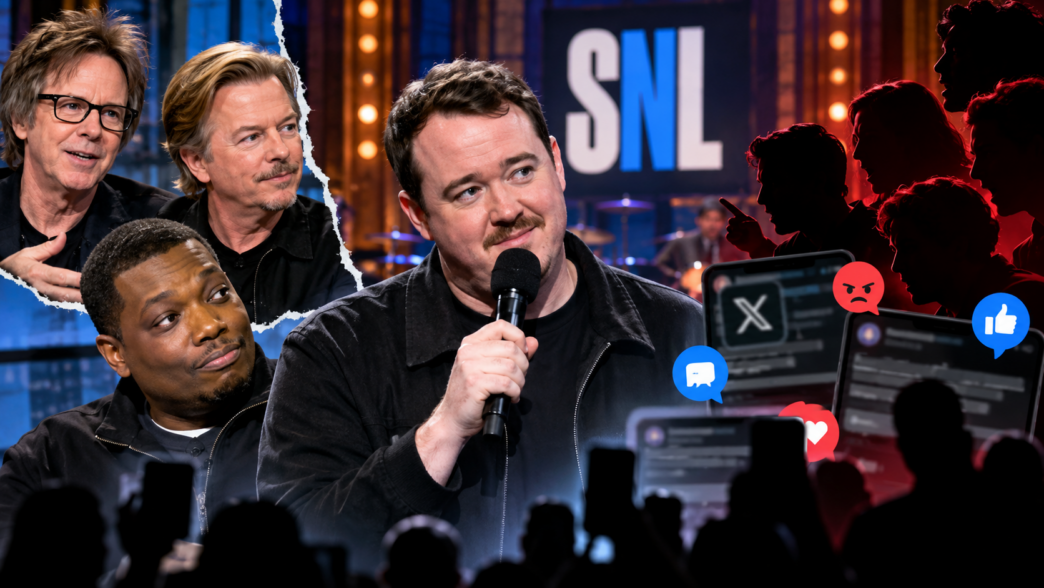
The outrage machine came for Shane Gillis again.
But this time, some Saturday Night Live veterans aren’t exactly lining up to help it.
Former SNL stars Dana Carvey and David Spade have pushed back on the growing controversy surrounding Gillis’ October 10 hosting appearance, while current “Weekend Update” anchor Michael Che has resisted demands that he publicly condemn the comedian.
Their reactions are turning what began as outrage over one provocative joke into a much bigger argument: Does every offensive joke require a public reckoning — or is comedy still allowed to offend people?
The Joke That Started the Firestorm
Gillis, making his third appearance as SNL host, sparked backlash during his opening monologue after joking about women’s increasingly revealing gym clothes and saying women at the gym now “dress like whores.”
The joke drew immediate criticism online and from celebrities including Dan Levy and former SNL cast member Ego Nwodim. Gillis also accidentally dropped an F-bomb later in the live broadcast during a Dr. Seuss-themed sketch, which he apologized for during the show.
The backlash didn’t disappear after the weekend.
Instead, it expanded into a celebrity referendum on Gillis, SNL, sexism and the limits of comedy.
Even Saturday Night Live UK got involved, using its own “Weekend Update” segment to mock Gillis over the controversy.
But then some familiar SNL names started pushing in the opposite direction.
Dana Carvey: It Was a Joke
Dana Carvey, who spent seven seasons on SNL, said on his “Fly on the Wall” podcast with David Spade that he simply didn’t understand the scale of the outrage.
Carvey said he viewed Gillis’ line as exactly what it was supposed to be: a joke, rather than a literal declaration about women.
He also acknowledged that the material may have been better suited for a comedy club than the Studio 8H audience, suggesting the same joke might land very differently depending on the room.
That’s an important distinction getting lost in much of the argument.
A joke can bomb. It can be crude. People can hate it.
None of those things automatically mean the comedian delivering it sincerely believes the literal premise of the joke.
David Spade Has a Different Problem With the Outrage
Spade took aim at another part of the controversy: the expectation that every celebrity and comedian must immediately issue an opinion.
“Relax,” was essentially his message.
He questioned why public figures were being pressured to weigh in on Gillis at all, arguing that society has reached a point where silence itself is treated as controversial.
Spade also suggested the backlash may ultimately help Gillis rather than hurt him.
That’s hardly an outrageous prediction.
Gillis has already lived through a far more serious cancellation attempt.
He was hired by SNL in 2019 and fired before appearing on the show after old clips surfaced containing racial and homophobic slurs. Yet instead of disappearing, Gillis built a massive stand-up audience, landed Netflix success with Tires and eventually returned to the same show that fired him — not once, but repeatedly. NBC confirmed his October 10 appearance marked his third time hosting.
That’s one reason another round of outrage may not have quite the effect critics expect.
Michael Che Refuses to Join the Pile-On
Current SNL star Michael Che also resisted being pushed into a simple condemnation.
During an October 15 appearance on Today, Che was repeatedly questioned about Gillis’ monologue.
His response was noticeably less dramatic than the outrage surrounding it.
“That’s comedy,” Che said, explaining that a comedian thinks something is funny and sometimes the audience doesn’t.
Che said he hadn’t watched the monologue live because he was preparing his own material. When pressed about Gillis’ joke, he acknowledged that comedians sometimes “swing and miss” and noted that he has done so himself.
That’s not exactly a full-throated endorsement of the joke.
But it also isn’t the denunciation critics were looking for.
And that middle ground may be precisely what this entire controversy is exposing.
Even SNL Is Divided
The SNL family itself is nowhere near united.
Former cast members Ego Nwodim and Cecily Strong mocked or criticized Gillis over the controversy, while Dan Levy publicly condemned the monologue.
Longtime cast member Kenan Thompson offered a more complicated response this week.
Thompson said he doesn’t necessarily view Gillis as a mean person, but said he would want to have a real conversation with him if Gillis returned. He also argued that the controversy surrounding one part of the monologue had overshadowed the rest of the episode.
At the same time, Thompson cautioned that jokes aren’t automatically harmless simply because the comedian intended them as jokes.
That may be the clearest indication yet that this story is no longer really about one line in a seven-minute monologue.
It’s about what comedy is supposed to be allowed to do.
The Bigger Fight Isn’t Going Away
Gillis has built much of his career by walking directly toward material other comedians might avoid.
His critics see that approach as lazy provocation or worse.
His defenders see something else: a comedian whose job is to push boundaries in a culture increasingly eager to police them.
And Carvey and Spade’s reaction raises a question worth asking.
If an offensive joke is treated not merely as a bad joke but as evidence of a comedian’s character, what incentive remains for comics to risk bombing at all?
Comedy has always depended on the possibility that somebody in the room won’t laugh.
The Gillis controversy suggests the fight now is over whether not laughing is enough — or whether every bad joke has to become a national scandal.