








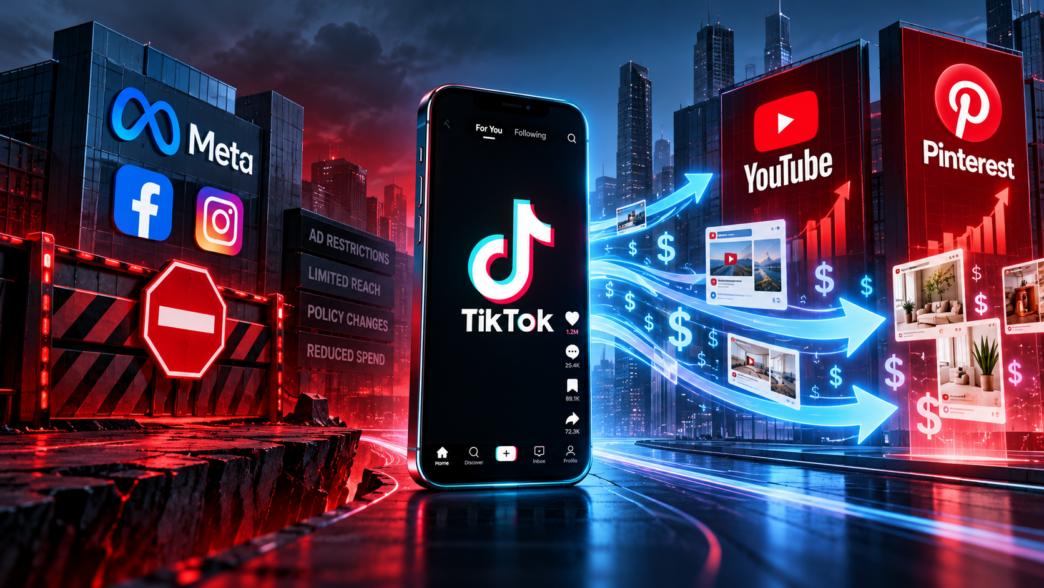
Meta wanted to stop TikTok from using Facebook and Instagram to attract users. Instead, the social media giant may have handed some of that advertising business straight to its biggest competitors.
After Meta blocked advertising from ByteDance, the company behind TikTok, across several major markets, TikTok began redirecting its advertising spending toward YouTube, Pinterest, and mobile advertising networks.
And the early numbers tell an interesting story.
According to Business Insider’s October 21 report, citing estimates from Sensor Tower, YouTube’s share of TikTok’s tracked advertising spending climbed from 9% during the first week of October to 17% between October 9 and October 16.
Pinterest saw an even bigger proportional jump, rising from 3% to 9%.
Meanwhile, mobile-app advertising networks, including Google’s AdMob, captured an estimated 58% of TikTok’s spending, up from 19%.
Those percentages represent estimated shares of advertising allocation, not independently confirmed dollar amounts.
But the direction is difficult to miss.
Meta closed the door. TikTok found other places to spend its money.
Meta’s Advertising Ban Was No Accident
The confrontation began on October 8, when Meta imposed restrictions on advertising by ByteDance across Facebook and Instagram.
The restrictions applied to seven countries: the United States, Canada, Egypt, Indonesia, Japan, Thailand, and Vietnam.
As Reuters reported on October 8, the restrictions also extend to third-party advertisers running campaigns that direct users to TikTok and other ByteDance services.
Meta made its position unusually clear.
“We don’t have to run ads from a competitor whose goal is to pull people off our apps,” the company said in a statement reported by Reuters.
It is a remarkable admission about how the biggest technology companies increasingly view their advertising businesses.
Meta isn’t simply selling advertising space. It is competing against the very companies that might want to purchase that space.
TikTok, with its enormous influence over short-form video, competes directly with Instagram Reels and Facebook for users, creators, and advertising budgets.
Allowing TikTok to advertise across Meta’s platforms essentially means helping a competitor attract people away from Meta’s own products.
From that perspective, the restriction makes business sense.
But it also raises a larger question: What happens when the companies controlling digital advertising decide their competitors are no longer welcome?
Google May Be the Unexpected Winner
Meta’s decision was aimed at TikTok.
But the early spending data suggests Google’s advertising ecosystem may be among the largest beneficiaries.
TikTok’s estimated allocation toward YouTube increased substantially following the restrictions, while mobile advertising networks such as Google’s AdMob absorbed an even larger share of the redirected spending.
Pinterest also emerged as a beneficiary, tripling its estimated share.
This creates an unusual competitive situation.
Meta wants to prevent TikTok from using Facebook and Instagram to recruit new users.
TikTok still needs advertising channels to promote its services.
Google and Pinterest are positioned to capture some of that demand.
The numbers don’t establish how much additional revenue those companies actually received, but they demonstrate where TikTok’s advertising strategy is moving.
And that could matter well beyond one advertising campaign.
As Bloomberg reported when the restrictions were announced, Meta’s decision represents another escalation in its competition with ByteDance.
That competition is no longer limited to building better features or attracting creators.
It now extends to deciding who can advertise on which platforms.
Big Tech’s Digital Walls Are Getting Higher
For years, companies treated social media platforms as advertising marketplaces where businesses could purchase access to enormous audiences.
Facebook, Instagram, YouTube, Pinterest, TikTok, and other services were competing advertising channels.
But the relationship becomes more complicated when the advertiser is also a direct competitor.
Meta’s latest decision illustrates that tension.
According to The Verge’s reporting on the restrictions, the policy covers not only direct advertisements from ByteDance but also certain third-party advertisements linking to TikTok.
That detail matters.
A business promoting its TikTok presence could face restrictions even if it isn’t owned by ByteDance.
The policy therefore extends beyond a straightforward corporate dispute between two technology giants.
It can also affect outside advertisers whose campaigns involve TikTok or related services.
For marketers, that introduces another layer of uncertainty into an already complicated digital advertising market.
A campaign that works today could become restricted tomorrow because two technology platforms change their competitive relationship.
Meta has defended the decision as a normal business practice.
And there is a reasonable argument behind that position: A private company generally has commercial discretion over which advertising relationships it chooses to maintain, subject to applicable laws.
But critics of increasingly closed technology ecosystems can point to another concern.
When a handful of companies control access to billions of users, their decisions can influence which services gain visibility and which struggle to reach audiences.
That is an important distinction.
The issue isn’t simply whether Meta should be required to sell advertisements to TikTok.
It’s how much power major technology companies should have over the distribution channels their competitors depend upon.
TikTok Isn’t Waiting for Meta to Change Its Mind
The advertising shift also reveals something important about TikTok’s position.
Losing access to Facebook and Instagram advertising in seven markets is a setback, but TikTok has alternatives.
YouTube offers access to a massive video audience.
Pinterest provides another channel for discovery and consumer-oriented marketing.
Mobile advertising networks allow TikTok to reach audiences across a much broader collection of applications.
That doesn’t necessarily make these channels equally effective.
Advertising performance varies by audience, cost, placement, and campaign objective.
But diversifying spending gives TikTok a way to continue promoting its services without relying on a direct rival.
Business Insider’s reporting suggests that this transition is already underway.
The unanswered question is whether TikTok will maintain the new spending pattern or make further adjustments as it measures campaign performance.
There is also the possibility that other major technology companies could reconsider how much advertising access they provide to competing services.
Meta’s Move Could Change More Than TikTok’s Marketing
Meta can afford to be selective about its advertising customers.
Facebook and Instagram remain enormous advertising businesses, and ByteDance represents just one potential buyer.
But there is a strategic trade-off.
Blocking a competitor might protect Meta’s audience from direct promotional campaigns.
At the same time, it can redirect advertising spending toward other companies competing for the same digital advertising market.
That is exactly what the early Sensor Tower estimates suggest is happening.
Meta’s decision may have complicated TikTok’s marketing strategy, but it also created an opportunity for YouTube, Pinterest, and mobile advertising networks.
And for businesses dependent on major technology platforms, this fight offers a broader warning.
Digital advertising access is not guaranteed simply because a company is willing to pay.
Increasingly, it may depend on whether the platform selling that access considers the advertiser a customer — or a threat.
Meta has made its choice.
TikTok has responded by moving its advertising budget elsewhere.
Now the question is whether Meta’s competitors will continue benefiting from a restriction they never had to impose themselves.