







Elon Musk has finally shown the world a Tesla that can leave the ground.
And this time, it wasn’t just another futuristic promise.
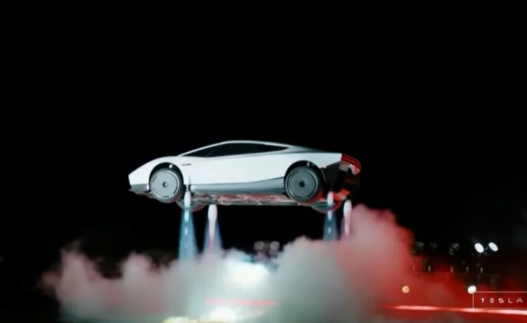
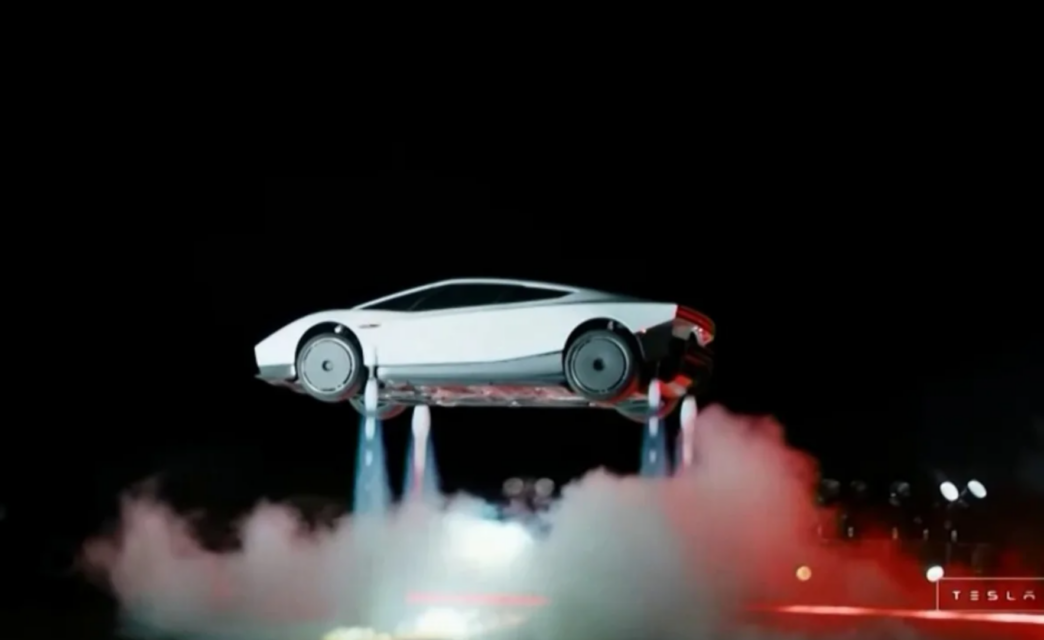
On October 15, 2026, Tesla unveiled its redesigned Roadster at SpaceX’s rocket testing facility in McGregor, Texas. The electric supercar drove upside down, launched into the air, performed a flip and landed on its wheels.
A second demonstration showed the vehicle jumping over several other Tesla vehicles.
The footage looked like something straight out of a science-fiction movie.
But while Musk’s latest creation represents an extraordinary display of engineering, there’s a catch: the flying version isn’t approved for public roads, and Tesla doesn’t expect production to begin until 2028.
Tesla Just Turned a Sports Car Into a Rocket
The new Roadster combines Tesla’s electric vehicle technology with propulsion systems developed using expertise from SpaceX.
Instead of relying on traditional aircraft wings or helicopter-style rotors, the car uses powerful cold-gas thrusters to propel itself through the air.
Tesla engineers also developed a suction system underneath the vehicle that can generate enough downforce to hold it upside down.
During the demonstration, the Roadster climbed a curved ramp, remained attached to the inverted surface and then launched into the air.
The car rotated before landing safely.
Musk reacted with three simple words:
“Well, it worked.”
According to Tesla’s engineering team, the prototype uses 10 propulsion nozzles and high-pressure air tanks to generate thrust.
The system relies on compressed air rather than burning conventional rocket fuel.
That distinction matters. The Roadster is not a traditional flying vehicle capable of sustained aircraft-style travel. What Tesla demonstrated was a car performing controlled, rocket-assisted aerial maneuvers.
Still, the engineering achievement is difficult to ignore.
Zero to 60 MPH in Just 0.81 Seconds
Flying wasn’t the only surprise.
During the unveiling, Tesla displayed a Roadster acceleration test showing 0 to 60 mph in just 0.81 seconds.
If independently verified in a production vehicle, that would represent an extraordinary acceleration achievement.
Tesla also announced performance targets that include:
A top speed exceeding 230 mph for the Rocket configuration.
More than 300 miles of estimated driving range.
Advanced aerodynamics and a multi-mode suction system.
SpaceX-inspired thrusters for acceleration and aerial maneuvers.
These figures are manufacturer claims. Independent production-vehicle testing has not yet confirmed them.
Tesla is planning three versions of the Roadster.
Performance: A two-seat, road-focused electric supercar using advanced aerodynamics and suction technology.
Thrust: A more extreme two-seat version featuring rear-mounted thrusters designed to deliver astonishing acceleration.
Rocket: A single-seat version equipped with a more extensive propulsion system capable of upward movement and aerial maneuvers.
The Rocket model is the closest thing to Musk’s vision of a flying car.
But it comes with serious limitations.
Here’s the Catch: You Can’t Legally Fly It Down the Highway
Tesla describes the Rocket version as an invitation-only vehicle and explicitly states that it is not approved for public road use.
That means the breathtaking stunts shown during the unveiling should not be mistaken for a feature buyers will legally be able to use on ordinary American streets.
Regulations, safety requirements and other technical questions remain unresolved.
There is also the question of cost.
Tesla has not announced a final purchase price for the new Roadster.
However, U.S. reservations for the Performance version require a total payment of $50,000, while the Thrust version requires $250,000.
Those amounts are reservation payments, not vehicle prices.
Tesla’s reservation terms also acknowledge that the Roadster remains under development and that delivery timing cannot be guaranteed.
The Rocket version is available by invitation only.
Tesla Promised the Roadster Years Ago. Will 2028 Be Different?
There is another important detail behind the excitement.
Tesla originally unveiled its second-generation Roadster in 2017, with production initially expected in 2020.
That deadline came and went.
Customers have waited years while Musk’s company shifted resources toward other vehicles, artificial intelligence, autonomous driving and robotics.
Now Musk says the redesigned Roadster will enter production in 2028.
But after nearly a decade of delays, that target deserves scrutiny.
The new vehicle also represents an interesting contradiction in Tesla’s strategy.
While the company increasingly focuses on autonomous transportation, Musk has described the Roadster as the ultimate car for human drivers.
In a world where Tesla wants vehicles to drive themselves, its most outrageous machine is being designed for people who still want to take the wheel.
An Engineering Breakthrough — or the Ultimate Tesla Publicity Stunt?
The Roadster demonstration proved something important: Tesla and SpaceX engineers have built a prototype capable of maneuvers that ordinary production cars cannot perform.
It also demonstrated Musk’s ability to generate enormous attention with a single product unveiling.
But there is a difference between demonstrating extraordinary technology and delivering a practical, commercially available vehicle.
The new Roadster has not demonstrated sustained flight. Its most extreme version is not approved for public roads. Its final price remains unknown, and production is still years away.
None of that erases what Tesla accomplished in Texas.
A car flipped through the air, landed safely and showed what happens when automotive and aerospace engineers combine their technologies.
The spectacle was real.
Now comes the harder part: Can Elon Musk turn the flying Tesla Roadster from an astonishing prototype into a vehicle customers can actually own?
SEO PACKAGE
Focus keyphrase: Tesla flying Roadster
SEO title: Tesla Flying Roadster: Elon Musk’s Wild Reveal Explained
Slug: tesla-flying-roadster-elon-musk
Meta description: Elon Musk unveiled a Tesla Roadster that jumps, flips and uses SpaceX-inspired thrusters. But the flying version has a big catch. Here’s what we know.
Excerpt: Elon Musk has unveiled a Tesla Roadster capable of jumping and flipping through the air using SpaceX-inspired technology. With blistering acceleration, rocket-style thrusters and a 2028 production target, Tesla’s newest supercar is unlike anything the company has built before.
Primary category: Culture
Tags: Elon Musk, Tesla, Tesla Roadster, Flying Car, SpaceX, Electric Vehicles, Technology, Innovation, Future Cars
Untold tag: No
FEATURED IMAGE
Concept: A dramatic editorial illustration of the newly redesigned white Tesla Roadster lifting above a test track, with powerful thrusters underneath and a dark cinematic background.
Image-generation prompt:
Create a professional, ultra-realistic 16:9 digital-news editorial illustration of a futuristic white Tesla Roadster inspired by Tesla’s October 2026 unveiling. Show the sleek electric supercar briefly airborne over a dark automotive test track, with dramatic compressed-air propulsion effects below the vehicle. Cinematic lighting, realistic metallic reflections, detailed aerodynamic bodywork, subtle motion blur, premium automotive photography aesthetic, visually dramatic but believable. No text, no watermark, no added logos. This is a conceptual illustration, not a documentary photograph of the actual demonstration.
Alt text: Conceptual illustration of Elon Musk’s new white Tesla Roadster using SpaceX-inspired thrusters to lift into the air.