





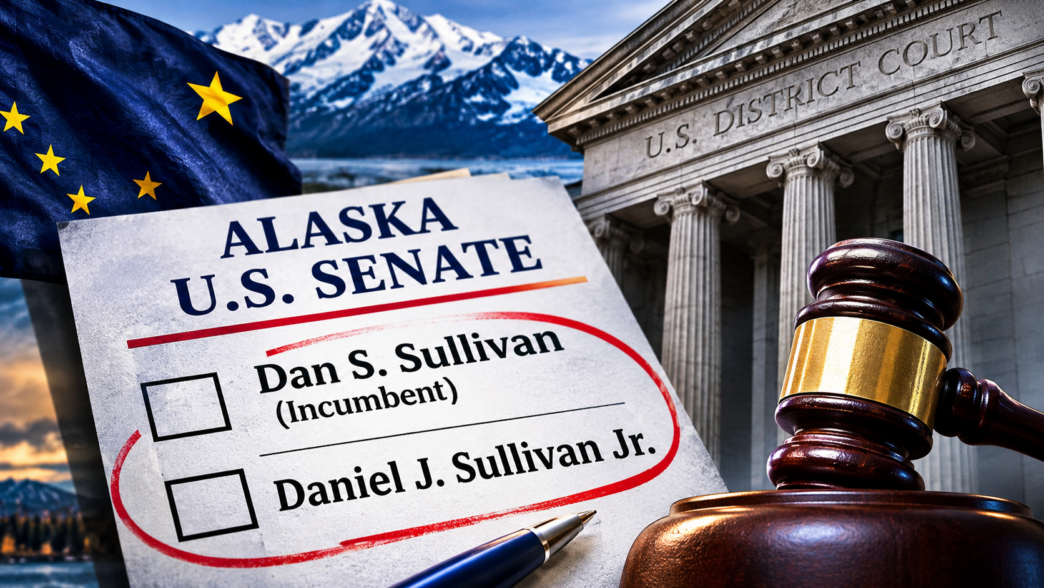
Alaska’s Senate race has taken an unusual turn. Two candidates share almost the same name, federal investigators are asking questions, and a judge has rejected the Justice Department’s attempt to intervene.
On November 1, U.S. District Judge Sharon Gleason dismissed a lawsuit filed by the Department of Justice (DOJ). The lawsuit sought to delay certification of Alaska’s Senate election results under certain conditions if Republican Sen. Dan Sullivan loses.
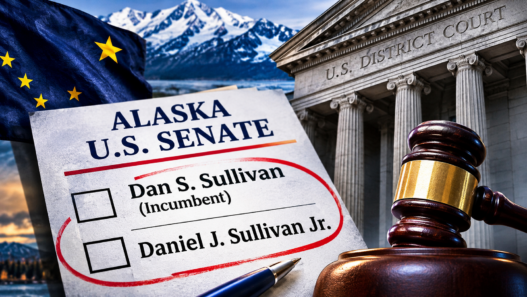
The dispute centers on another candidate, Daniel J. Sullivan Jr., a retired teacher whose name closely resembles the Republican incumbent’s.
According to the Associated Press, Republicans accuse political operatives linked to Democrats of recruiting the second Sullivan to confuse voters. However, the Democratic campaign denies involvement in such a scheme.
Now, with Election Day approaching on November 3, questions remain about how the second Sullivan entered the race.
Two Candidates, Almost Identical Names
Alaska voters face an unusual choice in the 2026 Senate election.
Republican incumbent Dan S. Sullivan is running against Democrat Mary Peltola. However, another candidate named Daniel J. Sullivan Jr. is also on the ballot.
The retired teacher received approximately 2.5% of the vote in Alaska’s August primary. As a result, he qualified for the general election under the state’s top-four primary system.
The 2026 Alaska Senate election overview from Ballotpedia confirms the primary results and explains how both Sullivan candidates reached the ballot.
Republicans previously challenged the second Sullivan’s candidacy. Nevertheless, the Alaska Supreme Court ruled that he could remain in the race.
The controversy did not end there.
Sen. Sullivan and his allies claim the retired teacher entered the election to draw votes away from the Republican incumbent.
Daniel J. Sullivan has denied trying to confuse voters.
The central question is whether his candidacy was an independent political decision or part of a coordinated effort to influence the election.
Federal Investigators Are Asking Questions
The controversy has moved beyond campaign accusations.
Federal investigators are examining allegations involving the second Sullivan’s entry into the race.
According to CBS News, the Justice Department issued subpoenas as part of a criminal investigation into the alleged recruitment effort.
The Associated Press also reported that FBI agents contacted donors to Daniel J. Sullivan. Investigators reportedly asked whether some donors had confused him with the Republican senator.
These developments show that federal authorities are examining the allegations.
However, an investigation does not establish that anyone committed a crime. As of November 2, no criminal charges had been announced in connection with the alleged scheme.
Meanwhile, Peltola has denied involvement in an effort to mislead voters.
Reports have raised questions about whether individuals connected to Democratic political organizations helped recruit the second Sullivan. Still, those allegations remain disputed.
Why the Judge Rejected the DOJ Lawsuit
The Justice Department wanted Alaska to delay certification under certain circumstances while officials investigated possible voter confusion.
However, Judge Gleason rejected the request.
According to Alaska Public Media, the judge found that federal officials had failed to provide a workable plan for investigating the disputed ballots.
One major concern involved ballot secrecy.
Federal officials had not explained how investigators could identify votes potentially affected by confusion without violating voters’ privacy.
The court also found that the Justice Department had failed to meet the legal requirements for bringing the case.
Additionally, the lawsuit arrived after early voting had already begun.
As Reuters reported, the judge concluded that the government’s proposed approach was not feasible.
The ruling dealt a setback to the Justice Department’s attempt to intervene in the election process.
Nevertheless, the department announced plans to appeal.
What Is Confirmed — and What Remains Unanswered?
The Alaska Senate ballot fight involves several established facts.
- Two Sullivan candidates: Both Dan S. Sullivan and Daniel J. Sullivan Jr. appear on the general election ballot.
- Primary results: The second Sullivan received enough votes to advance from Alaska’s August primary.
- Federal investigation: Investigators have issued subpoenas and contacted individuals connected to the disputed candidacy.
- Court ruling: Judge Gleason dismissed the Justice Department’s lawsuit on November 1.
- Political allegations: Republicans claim the second Sullivan was recruited to confuse voters, while Peltola’s campaign denies involvement.
What remains unclear is whether anyone deliberately organized the second Sullivan’s candidacy to influence the result.
Federal investigators have not publicly established that an illegal scheme occurred.
Furthermore, the court’s dismissal did not resolve the factual allegations. Instead, it addressed whether the Justice Department could obtain its requested legal remedy.
That distinction matters.
Why This Alaska Senate Dispute Matters
The controversy comes during a closely watched battle for control of the U.S. Senate.
Alaska uses ranked-choice voting in its general elections. Voters can rank candidates in order of preference, and votes may transfer between candidates as the counting process continues.
Because of that system, confusion between two candidates with similar names could affect how voters record their preferences.
However, the existence of similar names does not prove that voters were actually confused.
It also does not establish that the second Sullivan’s candidacy was unlawful.
Still, the allegations have raised questions about campaign tactics, candidate recruitment, and election oversight.
For now, both Sullivan candidates remain on the ballot.
Alaskans will vote on November 3, 2026, while the Justice Department pursues its appeal and federal investigators continue examining the allegations.
The election will determine who represents Alaska in the Senate. The separate investigation may determine whether the controversy surrounding the two Sullivan candidates leads to further legal action.