
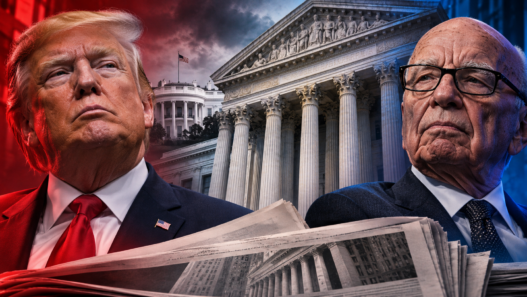






President Donald Trump’s legal war with The Wall Street Journal and Rupert Murdoch has suffered its biggest setback yet — and this time, the judge shut the door on simply filing the same case again.
U.S. District Judge Darrin P. Gayles on October 31 dismissed Trump’s amended $10 billion defamation lawsuit with prejudice, ruling that the president had again failed to plausibly show that the Journal, its reporters and other defendants published their controversial Jeffrey Epstein story with “actual malice.” The full 20-page federal court order is available through Justia. Read the federal court ruling
That matters. Trump had already been given a chance to repair his case after an earlier dismissal in April. He filed an amended complaint. Gayles still found it insufficient.
Now Trump’s lawyers say they intend to appeal.
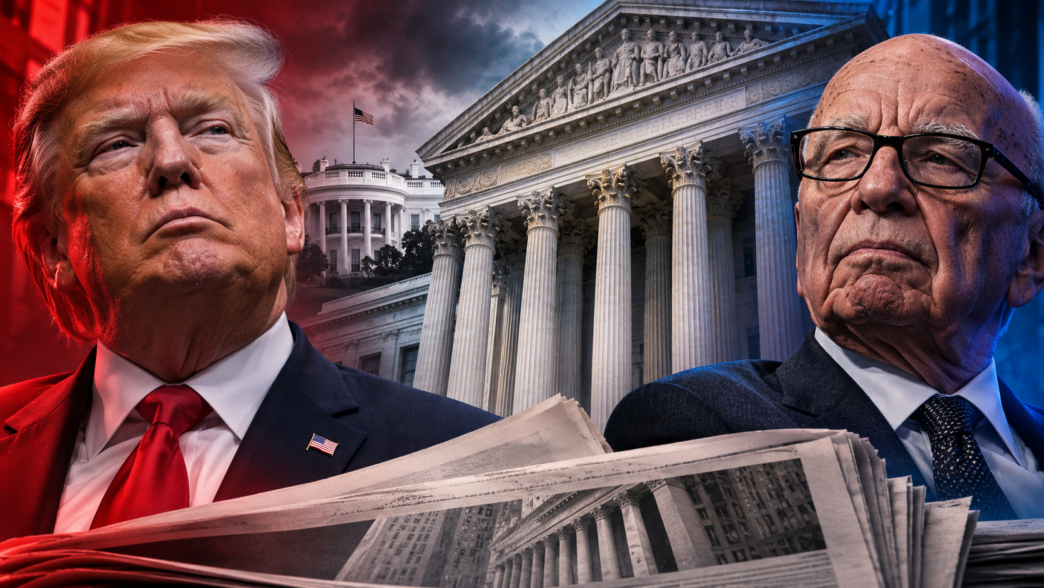
And underneath the legal fight is a much bigger political-media battle: Donald Trump versus Rupert Murdoch’s media empire.
The Epstein Story at the Center of the Fight
The lawsuit traces back to a July 2025 Wall Street Journal article describing a birthday letter that the newspaper reported bore Trump’s name and appeared in an album prepared for Jeffrey Epstein’s 50th birthday in 2003.
Trump has emphatically denied writing the letter and has maintained that the material is fake.
The Journal’s reporting said its journalists had reviewed the letter before publication. Trump argued that the newspaper published a damaging story despite being directly warned that the material was false.
According to the amended lawsuit, Trump even contacted Murdoch personally before the article appeared. The complaint said Murdoch told Trump he would “handle” the matter — something Trump believed meant the story would not run. Reuters reported on that allegation when Trump refiled the case in May. Read Reuters’ report on Trump’s amended lawsuit
The story was published anyway.
Trump sued Dow Jones, News Corp, Murdoch, News Corp CEO Robert Thomson and Journal reporters Khadeeja Safdar and Joe Palazzolo, seeking at least $10 billion.
The Judge Wasn’t Persuaded
The central problem for Trump was the extraordinarily high legal standard public figures must overcome in American defamation cases.
Under the “actual malice” standard, Trump needed to plausibly allege that the defendants published the disputed claims knowing they were false or with reckless disregard for whether they were false.
Gayles concluded that Trump’s amended complaint still did not get there.
The judge described some of Trump’s allegations as “conclusory” and “vague” and rejected the argument that the newspaper’s decision to publish after Trump denied writing the letter was evidence of actual malice.
Gayles also pointed to the Journal’s pre-publication reporting process. According to the court order, reporters sought comment from Trump and his team, the Justice Department, the FBI, Ghislaine Maxwell and other people connected to the birthday book.
The ruling became particularly sharp when addressing Trump’s criticism of that investigation.
“Grasping at straws, the Amended Complaint attempts to manufacture flaws with the investigation.”
The court ultimately held that Trump had failed for a second time to plausibly allege actual malice. Because he had already been given an opportunity to amend the lawsuit, Gayles dismissed it with prejudice.
The Associated Press reported that Trump’s legal team has indicated it will appeal, while Dow Jones welcomed the decision. Read the Associated Press report
One Important Thing the Ruling Did NOT Decide
There is a distinction worth making because it is easy to lose in the headlines.
The judge did not rule that Trump wrote the Epstein letter.
Nor did the court resolve whether the Journal’s underlying description of the letter was ultimately true.
Gayles specifically declined to decide those factual questions because he concluded that Trump’s lawsuit failed at the actual-malice stage. The ruling states that whether Trump authored the letter is a factual question that could not be decided on a motion to dismiss.
That distinction is important.
The Journal won this round because Trump failed to satisfy the legal requirements for his defamation case — not because the court independently authenticated the disputed letter.
Trump vs. Murdoch Is the Bigger Story
That is where this case becomes more interesting than another courtroom defeat.
Murdoch is hardly a conventional Trump adversary. His companies have spent decades occupying enormous territory in conservative and center-right media, and Trump has maintained relationships with figures throughout the Murdoch world.
But those ties have repeatedly collided with Trump’s expectation that media organizations associated with conservative audiences should treat him differently from openly hostile outlets.
The Journal dispute brought that tension into unusually public territory.
Trump did not merely complain about a hostile newspaper report. He sued a Murdoch-controlled company for $10 billion, named Murdoch personally as a defendant and claimed the article inflicted enormous reputational and financial damage.
Reuters reported in July 2025 that Trump publicly suggested the Journal and Murdoch wanted to settle the lawsuit, saying he believed he had been treated unfairly by the newspaper. Read Reuters’ earlier report on the Trump-Murdoch dispute
Instead, the Journal fought.
And for now, it won.
The Case May Be Dismissed — but the Fight Isn’t Over
Trump’s lawyers have already signaled an appeal, meaning the legal battle could move to the 11th U.S. Circuit Court of Appeals.
There is also another unresolved financial question. The Journal defendants have sought attorneys’ fees under anti-SLAPP laws. Gayles did not decide that issue in the dismissal order and instead allowed the defendants to file a separate motion addressing whether Florida or New York law should apply.
So the $10 billion claim may be gone from the district court, but the Trump-Murdoch confrontation is far from forgotten.
The political significance is difficult to miss.
Trump has spent years attacking CNN, NBC, CBS, The New York Times and other institutions he considers hostile. A clash with The Wall Street Journal is different.
This one is a fight inside a media universe that has frequently shared audiences, political allies and ideological territory with Trump.
And after two attempts to make his case, a federal judge has now told the president that — at least at the trial-court level — he has not met the constitutional standard required to proceed.