









America votes Tuesday, and Republicans are heading into Election Day with something that looked almost unthinkable a year ago: serious Senate fights in states Donald Trump carried comfortably in 2024.
More than 54 million Americans have already cast early ballots ahead of the November 3 midterms. Republicans currently control the Senate 53-47 and hold a razor-thin 218–214 advantage in the House, with two House seats vacant. Democrats need a net gain of four seats in either chamber to take control.
The House may be the bigger immediate danger. Democrats are widely expected to make gains there, and several election models have them favored to win the chamber. But the Senate – once considered Republicans’ firewall – has become the real shock of this election.
For the GOP, survival may come down to defending Republican territory in Texas, Alaska, Ohio, Kansas and Maine while finding a way to steal back a Democratic seat in Michigan.
That is not the map Republicans expected to be fighting over.
The Republican Senate Math Is Getting Uncomfortable
Republicans can afford losses. They cannot afford a collapse.
With a 53-47 majority, the GOP needs to prevent Democrats from posting a net gain of four seats. That means Republicans do not necessarily need to win every battleground – but they need enough victories across an increasingly hostile map to keep Democrats below 51 seats.
The alarming part for Republicans is where some of those battlegrounds are.
Reuters reported Monday that Democrats were narrowly ahead in polling in several Republican-held Senate contests, including Alaska, Kansas, Maine, Ohio and Texas. Republicans’ best chance to offset those losses appears to be Michigan.
In other words, the GOP is no longer simply defending swing states. It is defending states Trump won by double digits.
Texas: A Race Republicans Were Never Supposed to Sweat
Texas may be the most politically embarrassing battleground for Republicans.
Trump carried the state by nearly 14 points in 2024. Democrats have not won a statewide Texas election since 1994.
Yet Republican Senate nominee Ken Paxton is locked in a competitive contest with Democratic state Rep. James Talarico after Paxton defeated incumbent Sen. John Cornyn in the Republican primary.
Republicans and allied groups have poured extraordinary amounts of money into the state, with Reuters reporting roughly $300 million in Republican spending. Recent polling cited by Reuters has shown Talarico ahead, although the margins vary considerably by survey.
Texas turning genuinely competitive does not mean Democrats have suddenly transformed the state blue. It does mean Republicans are spending money and political attention somewhere that, under normal circumstances, should have been locked down months ago.
Alaska: Another Trump State Suddenly in Play
Alaska presents another uncomfortable problem.
Republican Sen. Dan Sullivan is facing former Democratic Rep. Mary Peltola in a state Trump won by 13 points in 2024. Polling cited by Reuters has shown Peltola narrowly ahead.
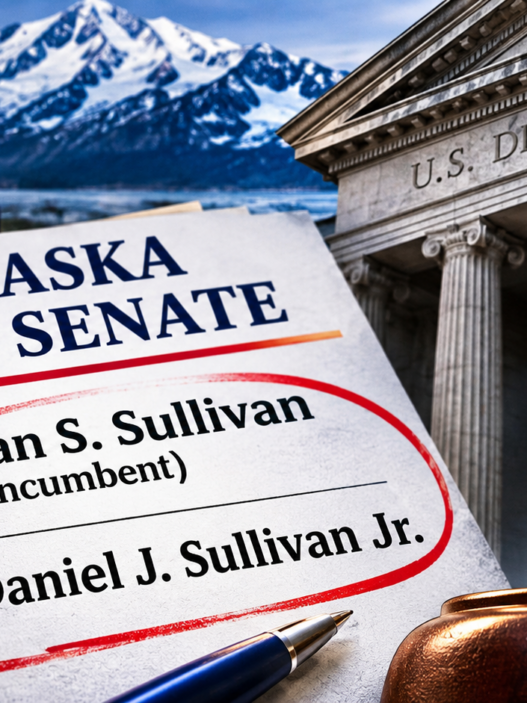
The race has also become tangled in controversy over another candidate sharing Sullivan’s name. The Justice Department challenged Alaska over how the election could be certified if the namesake candidate affected a narrow result, but a federal judge dismissed the administration’s lawsuit. The Justice Department has said it is appealing.
Whatever happens legally, Republicans would much rather be talking about expanding the Senate map than fighting to save Alaska.
Ohio: Sherrod Brown Is Trying to Come Back
Ohio has moved sharply toward Republicans in recent presidential elections, but Democrats are betting that former Sen. Sherrod Brown can pull off a comeback.
Brown, who lost his Senate seat in 2024, is running against Republican Sen. Jon Husted, who was appointed after JD Vance became vice president.
The race has attracted enormous spending, and Reuters reported that recent polling has ranged from a tie to a Brown advantage of as much as five points.
For Republicans, Ohio is exactly the kind of state they need to hold if they want their Senate majority to survive even a moderately strong Democratic year.
Kansas: The Race That Should Terrify the GOP
Then there is Kansas.
Trump won the state by 16 points in 2024. Kansas has not elected a Democratic U.S. senator since 1932.
And yet Republican Sen. Roger Marshall is facing a competitive challenge from Democrat Adam Hamilton.
Reuters reported that Republican groups have shifted resources into Kansas as the race tightened, with at least one recent poll showing Hamilton narrowly ahead.
If Democrats actually win Kansas, Republicans will probably have much bigger problems elsewhere on the map.
Kansas is not merely another toss-up. It is the kind of result that would suggest a national political wave.
Maine: Susan Collins Faces Another Survival Test
Maine has always been one of Democrats’ most obvious Republican targets.
Sen. Susan Collins is seeking another term in a state Trump lost in 2024, facing Democrat Troy Jackson.
Collins has survived difficult elections before by cultivating an independent image, but this race has remained stubbornly competitive. Recent polling cited by Reuters has shown Jackson ahead, while Republican outside groups have heavily outspent Democrats in an effort to protect Collins.
Republicans can survive losing Maine.
Losing Maine while also dropping two or three states like Alaska, Ohio, Kansas or Texas is another story entirely.
Michigan Could Be the GOP’s Escape Hatch
If Republicans are looking for a Democratic-held seat to compensate for losses elsewhere, Michigan may be their best opportunity.
Republican Mike Rogers is running against Democrat Abdul El-Sayed for an open Senate seat.
The race took a bizarre turn Sunday when Democratic Rep. Haley Stevens – who lost the Democratic Senate primary – endorsed Rogers instead of El-Sayed, exposing a Democratic split just before Election Day.
That endorsement gave Republicans exactly the kind of late-breaking storyline they wanted. But polling remains a warning sign: a New York Times/Siena survey reported by Reuters showed El-Sayed leading Rogers 53% to 42%.
So Michigan may be Republicans’ best offensive opportunity, but it is hardly an easy pickup.
The House Could Fall Even If the Senate Survives
The Senate map is dramatic, but the House may be where Republicans are most vulnerable.
Democrats need only four net seats to overturn the GOP’s current 218-214 advantage, and Reuters reported Monday that Democrats are widely expected to reclaim the chamber.
Losing the House would dramatically change the final two years of Trump’s term.
Democrats would control committees, gain subpoena power, and be positioned to launch investigations into the administration while blocking much of the Republican legislative agenda. Senate control would be even more consequential because it would affect judicial and executive-branch confirmations.
A Republican Senate with a Democratic House would mean divided government.
A Democratic sweep would be a far more serious political setback for Trump.
Tomorrow Is About More Than One Election
There is a temptation to frame every midterm as a referendum on the president. This one actually has the potential to reshape Washington almost overnight.
Republicans entered Trump’s second term controlling the White House and both chambers of Congress. By Wednesday morning – or whenever the closest races are finally resolved – that unified control could be gone.
And the most telling part of the map may not be whether Democrats win Maine or whether Republicans flip Michigan.
It may be whether Republicans can still reliably win places like Texas, Kansas, Alaska and Ohio when the national political environment turns against them.
If those states hold, the GOP may escape with its Senate majority intact.
If several of them fall together, Tuesday will not look like a handful of isolated Republican defeats.
It will look like a wave.