







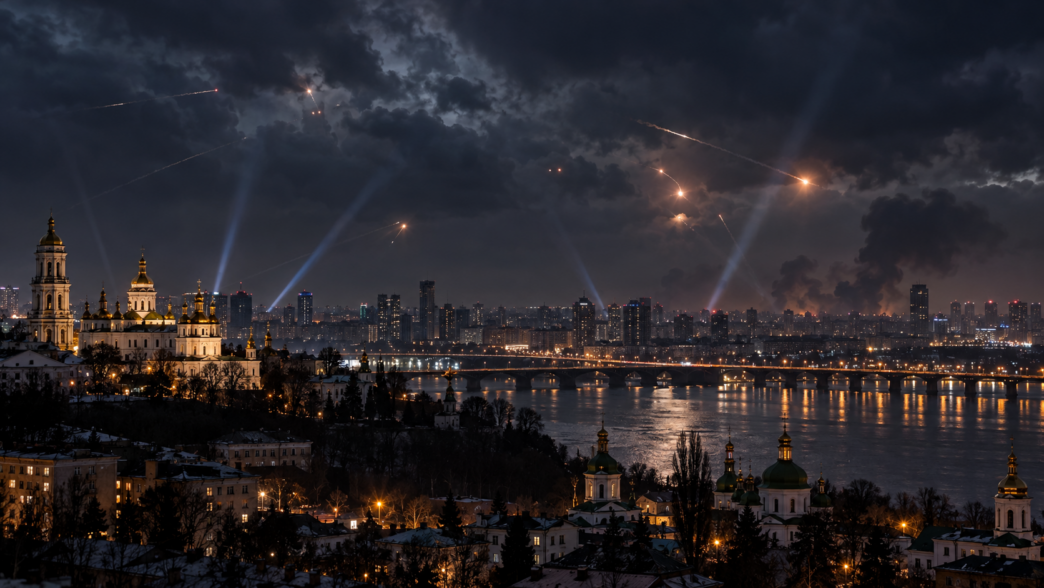
Russia unleashed another major ballistic missile assault on Kyiv overnight Thursday, even as Moscow and Washington discussed restarting negotiations aimed at ending the war in Ukraine.
The timing was impossible to ignore.
Russian President Vladimir Putin had just met U.S. special envoy Steve Witkoff in St. Petersburg, where the Kremlin said Putin had agreed in principle to resume U.S.-mediated negotiations with Ukraine. Hours later, air-raid sirens sounded over Kyiv and missiles began hitting the Ukrainian capital.
According to Reuters’ latest reporting on the strikes, Ukraine said Russia fired at least 21 ballistic missiles in three waves toward Kyiv. Ukrainian President Volodymyr Zelenskyy said three of the missiles carried cluster munitions, an allegation Russia had not publicly responded to at the time of reporting.
And Ukraine was striking back.
Russian officials claimed Ukraine launched 630 drones toward Moscow overnight, one of the largest drone waves Russia has reported during the war. Moscow Mayor Sergei Sobyanin said most were intercepted before reaching the capital, while two people were reported wounded near Moscow. The Russian claim regarding the total number of drones has not been independently verified.
Kyiv Hit Hours After New Peace-Talk Discussions
The overnight bombardment damaged parts of Kyiv, including transportation infrastructure around the Southern Bridge across the Dnipro River.
Earlier reporting from Reuters on the first wave of attacks said at least 15 people had been wounded in Kyiv. As emergency crews assessed additional damage across the country, Zelenskyy later said two people had been killed and 34 injured across 12 Ukrainian regions. Casualty figures remained subject to change.
Russian attacks were reported elsewhere in Ukraine as well. A strike in the northeastern Kharkiv region killed a woman and injured four people, according to the regional governor, while Ukrainian officials said energy infrastructure around Kremenchuk in the Poltava region was also hit.
Russia’s Defense Ministry said its overnight operation targeted port infrastructure in the Odesa region and vessels it said were being used by the Ukrainian military.
Ukraine Sends Hundreds of Drones Toward Russia
Ukraine’s response was extensive.
Beyond Moscow, drones were reported around Lipetsk, roughly 250 miles south of the Russian capital. The regional governor said apartment buildings and a medical facility were struck and one person was injured.
Russian officials also reported a man killed and another wounded by Ukrainian drones in the Belgorod border region.
The scale of the overnight exchanges shows just how far the war remains from an actual ceasefire, regardless of what may be happening at the negotiating table.
Both sides have increasingly relied on long-range attacks as ground fighting has produced relatively limited territorial movement. Russia has repeatedly targeted Ukraine’s power and transportation infrastructure, while Ukraine has used long-range drones against Russian oil refineries and other targets deep inside Russian territory.
Washington Is Trying to Restart Negotiations
The military escalation comes at a particularly sensitive moment for the Trump administration’s latest diplomatic push.
Witkoff met Zelenskyy and European officials in Oslo before traveling to Russia to meet Putin. A U.S. official described the earlier discussions as covering elements of a possible peace framework, including security guarantees for Ukraine and a broader European security arrangement.
After the Putin-Witkoff meeting, Moscow said it was prepared to return to U.S.-mediated negotiations next month. Zelenskyy has also publicly supported renewed talks and said he hoped negotiations could take place in early November.
But the Kremlin is already signaling that major disagreements remain.
Kremlin aide Yuri Ushakov said Washington had brought Moscow new ideas emerging from the Oslo discussions but added that those ideas did not completely satisfy the Russian side. Reuters also cited a senior Russian official as describing the Putin-Witkoff meeting as relatively short and not substantive.
That leaves a major gap between agreeing to talk and agreeing on anything that could actually stop the fighting.
The Question Now: Negotiations or More Escalation?
The latest barrage does not prove negotiations are doomed. Wars have repeatedly continued — and sometimes intensified — while diplomats negotiate.
But it does underline the problem facing Washington.
Russia and Ukraine may both be willing to send representatives back to the negotiating table while simultaneously escalating the military pressure they hope will strengthen their position once they get there.
For the Trump administration, the next test will be whether renewed diplomacy produces something more concrete than another meeting date.
For Ukrainians waking up to damaged buildings and missile debris in Kyiv, the difference between talk of peace and peace itself remains very real.